Desert Tours
Ait Benhaddou Guide: History, Films and How to Visit
Ait Benhaddou is a fortified earthen village (ksar) in southern Morocco, about 3.5–4 hours' drive from Marrakech over the Tizi n'Tichka pass. A UNESCO World Heritage Site since 1987, it was once a stop on the caravan route to the Sahara and has appeared in films such as Gladiator and the series Game of Thrones.
- Location: Ounila Valley, Ouarzazate province, about 30 km north-west of Ouarzazate.
- From Marrakech: about 190 km, 3.5–4 hours by road via Tizi n'Tichka (about 2,260 m).
- UNESCO: inscribed in 1987 as the Ksar of Ait-Ben-Haddou.
- Famous on screen: Gladiator, The Mummy, Kingdom of Heaven, Game of Thrones.
- Time needed: 1.5–2 hours to walk up to the hilltop granary and back.
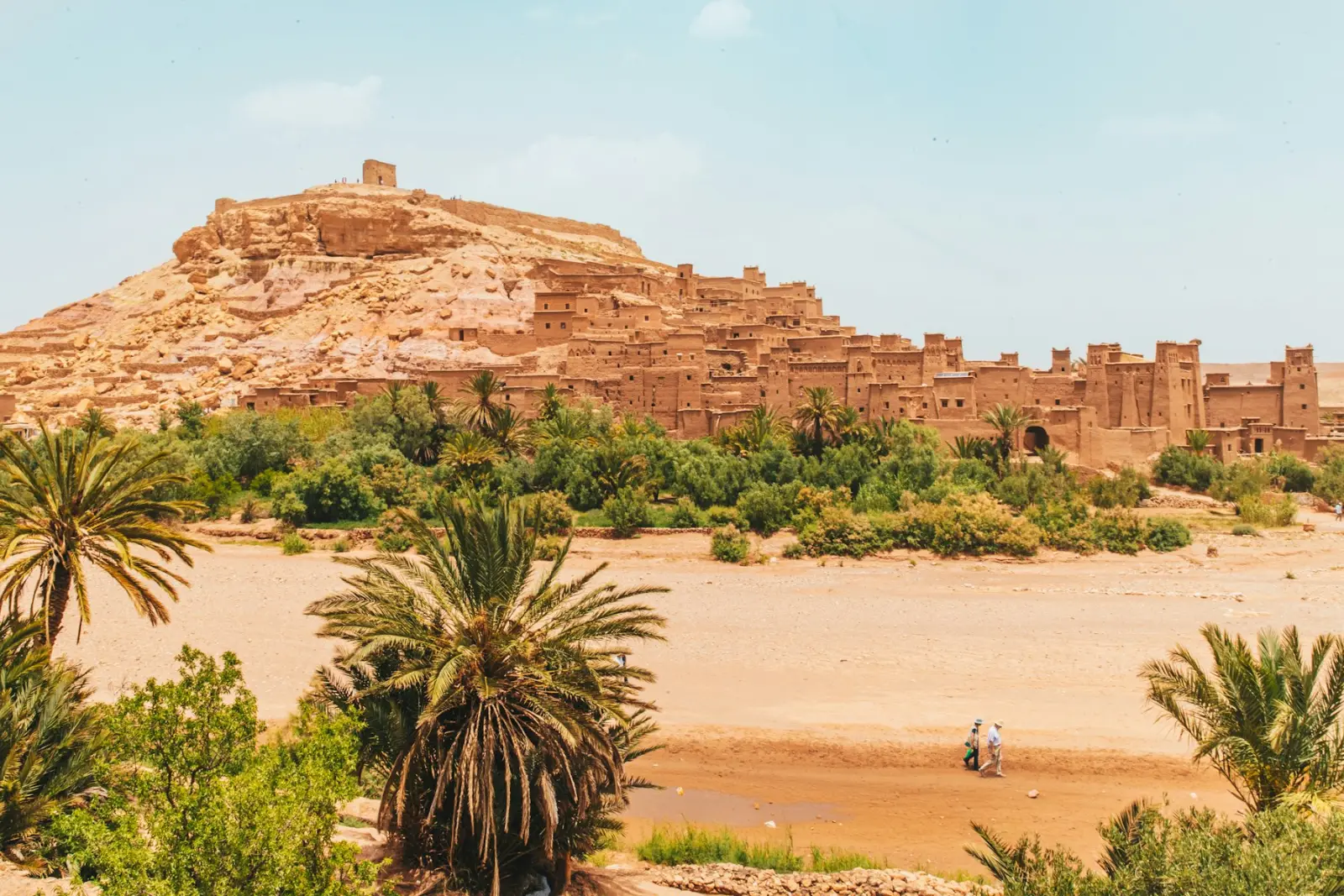
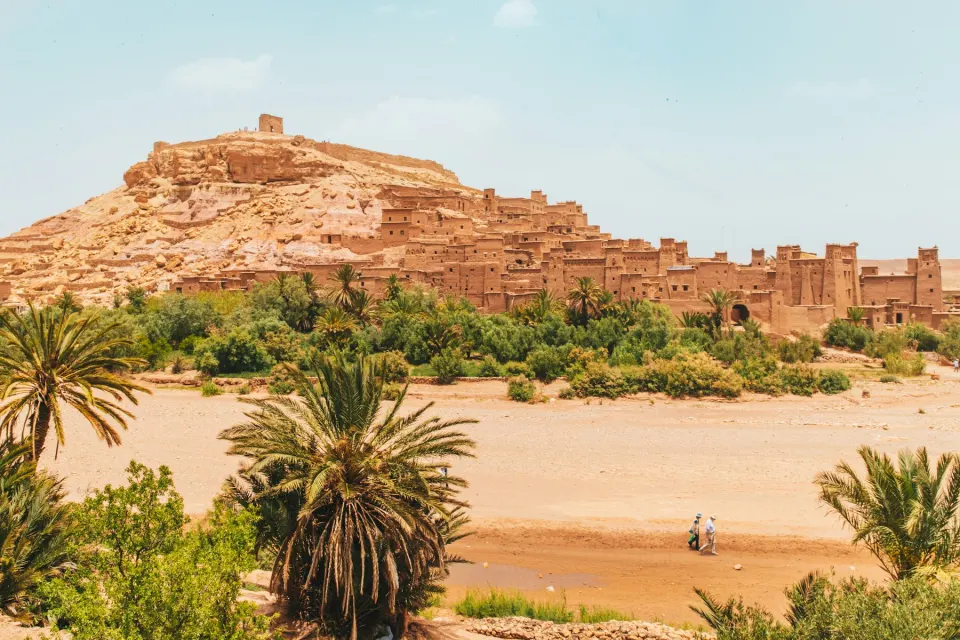
If you have seen a photo of a golden mud-brick village stacked up a hillside above a riverbed, you have probably seen this place. It is one of the most photographed places in Morocco and a highlight of almost every trip south of the High Atlas. Our drivers stop here on every 3-day Marrakech to Merzouga desert tour, so this guide reflects what we see week after week: the history, the film connections, and how to get the most from your visit.
What is Ait Benhaddou?
It is a ksar — a group of earthen houses, kasbahs and communal buildings enclosed by defensive walls. The buildings are made of rammed earth and mud brick mixed with straw, reinforced with wooden beams, which gives the village its warm ochre colour. At the top of the hill sits an agadir, a fortified collective granary where families once stored grain in times of trouble.
Today only a handful of families still live inside the old ksar; most residents moved to the newer village across the Ounila river, which has electricity, running water and road access. The old village is kept alive by those families, small shops, artists and guesthouses, and by ongoing restoration work.
A short history of Ait Benhaddou
The site sits on one of the historic trans-Saharan caravan routes linking the Sahara and the lands to the south with Marrakech. Caravans carrying salt, gold, dates and other goods passed through the Ounila Valley on their way across the High Atlas, and fortified villages like this one offered shelter, water and protection.
Earth buildings need constant maintenance, so although the location has been settled for centuries, most of the structures you see today are believed to date from the 17th century or later. When the new road over the Tizi n'Tichka pass and the rise of Ouarzazate shifted traffic away from the old route in the 20th century, the village declined — until its architecture brought it a new life through tourism and cinema.
Why is Ait Benhaddou a UNESCO World Heritage Site?
UNESCO inscribed the Ksar of Ait-Ben-Haddou on the World Heritage List in 1987 as a striking example of southern Moroccan earthen architecture and of the pre-Saharan building traditions found in the Draa, Todra, Dades and Souss valleys. Its listing has helped fund restoration and keep the village from collapsing back into the earth it was built from.
Which films and series were shot at Ait Benhaddou?
Thanks to its dramatic setting and the film studios in nearby Ouarzazate, the ksar has been used as a location for decades. It has stood in for ancient cities, biblical towns and fantasy worlds. Among the best-known productions filmed here or in its immediate surroundings:
| Production | Year | What to look for |
|---|---|---|
| Gladiator | 2000 | The provincial town where Maximus fights as a gladiator; a set arena was built near the ksar. |
| The Mummy | 1999 | Scenes set in ancient and 1920s Egypt. |
| Kingdom of Heaven | 2005 | Crusades-era scenes in the Holy Land. |
| Game of Thrones | Season 3 (2013) | Daenerys's journey through Slaver's Bay, including the city of Yunkai. |
| Lawrence of Arabia | 1962 | Often cited as one of the earliest major productions in the area. |
Your guide or driver can point out the spots where well-known scenes were shot. If you are a film fan, consider a stop at one of the studios in Ouarzazate, about 30 minutes away, where props and sets from many productions are on display.
How to visit Ait Benhaddou from Marrakech
The ksar lies about 190 km south-east of Marrakech. The road climbs through Berber villages and walnut groves to the Tizi n'Tichka pass at about 2,260 m, then descends towards Ouarzazate. Allow 3.5–4 hours each way without long stops — more in winter if there is snow on the pass.
Option 1: As part of a Sahara desert tour (recommended)
The easiest and most rewarding way to see the ksar is on the way to the desert. Our 3-day tour stops here on day one before continuing via Ouarzazate to the Dades Valley, then to the Todra Gorge and the Merzouga dunes. You get the ksar, the High Atlas and the Sahara in one trip. For the full route, see our Marrakech to Merzouga desert guide. If you prefer more comfort, the luxury 3-day Sahara tour follows the same road.
Option 2: A day trip from Marrakech
A day trip to Ait Benhaddou and Ouarzazate is possible, but it means 7–8 hours of driving for a couple of hours on site. It suits travellers with no time for the desert. We arrange it as a private trip — ask us on WhatsApp for today's price.
Option 3: Stay overnight
Sleeping in a guesthouse in or opposite the ksar lets you see the village at sunset and early morning, when the light is warm and the coach groups have gone. It works well on longer journeys such as our tailor-made private Morocco tour or the 7-day tour from Casablanca.
What to see inside the ksar
- The river crossing: a footbridge links the new village to the old ksar; in dry months you can also step across the riverbed on stones.
- The main gate and lanes: narrow, stepped alleys wind up between the houses, some with artists selling paintings made with saffron, tea and indigo that change colour when heated.
- Traditional houses: a few families open their homes; they may ask for a few dirhams to look inside.
- The agadir (granary): the climb to the top takes 15–20 minutes and gives a sweeping view of the Ounila Valley, the ksar's rooftops and, on clear days, the High Atlas.
Practical tips for your visit
- Entry: walking through the village is free; some houses and guides charge small fees.
- Shoes: wear trainers or walking shoes — paths are uneven and dusty.
- Heat: from June to September, visit early or late and carry water; there is little shade near the top.
- Respect: people still live here, so ask before taking portraits and keep voices down near homes.
- Lunch: restaurants in the new village serve tagines with views across to the ksar.
For background reading, the Moroccan National Tourist Office also covers the Ouarzazate region and its kasbahs.
Nearby stops worth combining
- Telouet Kasbah: a detour off the Tichka road leads to the crumbling former seat of the Glaoui family, with painted ceilings and tilework inside.
- Ouarzazate: the Taourirt Kasbah in the town centre and the film studios on the outskirts make a good pairing with the ksar.
- Ounila Valley: the old caravan road between Telouet and the ksar runs past green terraces, small villages and red canyon walls, and can be driven in good weather.
Our drivers adjust stops to the season and to how much time you want on your feet, so tell us before departure which of these interest you.
Is Ait Benhaddou worth visiting?
Yes. Even if you have seen it on screen, standing on the granary hill with the river and palm trees below is memorable, and it is the best-preserved example of a ksar that most travellers will see. Combined with the High Atlas crossing, it turns the first day of a desert trip into a highlight in its own right rather than just a long drive.
Visit the ksar on your way to the Sahara
Our 3-day Marrakech to Merzouga desert tour stops at Ait Benhaddou on day one, from MAD 1,200 per person (about €110) — message Walid on WhatsApp at +212 611-965381 to reserve your seat.
Frequently asked questions
How far is Ait Benhaddou from Marrakech?
Which Game of Thrones scenes were filmed at Ait Benhaddou?
Do you need a ticket to enter Ait Benhaddou?
Can I visit Ait Benhaddou as a day trip from Marrakech?
Founder of Pure Morocco Experience, born and based in Morocco. Walid and his team of drivers and guides run desert tours from Marrakech every week. More about us.