Travel Tips
Best Time to Visit Sahara Desert Morocco: Month-by-Month
The best time to visit the Sahara desert in Morocco is spring (March to May) and autumn (late September to November). Days are warm at roughly 23–30°C and nights are cool but comfortable. Summer often passes 40°C in Merzouga, while winter brings mild, sunny days and nights close to freezing.
- Best time to visit Sahara desert Morocco: March, April, October and November
- Hottest months: July and August, with daytime highs often above 40°C
- Coldest nights: December and January, around 0–5°C at camp
- Rain: rare all year; the desert is dry in every season
- Tours run: all year round, with timings adapted to the season
As a Marrakech-based operator, we run desert trips every month of the year, and our guides will tell you the same thing: there is no bad month to see the dunes, only months that need different planning. Choosing the best time to visit Sahara desert Morocco trips comes down to how you handle heat, how cold you are willing to sleep, and how busy you want the dunes to be. This guide breaks it down month by month, focusing on Merzouga and the Erg Chebbi dunes, where our 3-day Marrakech to Merzouga desert tour spends its night at camp.
When is the best time to visit Sahara desert Morocco tours?
For most travellers, the answer is the two shoulder seasons. In spring, the Atlas Mountains are often still capped with snow, the valleys around Dades and Skoura are green, and the desert is warm without being exhausting. In autumn, the summer heat breaks, the date harvest begins around the oases of Erfoud and Tafilalet, and the light on the dunes is soft and golden.
The trade-off is popularity. Easter, May bank holidays and the October half-term are among the busiest weeks of the year, so we suggest booking a few weeks ahead if your dates are fixed.
Sahara weather month by month
The table below shows approximate average temperatures for Merzouga. Real conditions vary from year to year, and the desert can surprise you with a hot day in February or a chilly evening in May, so treat these as a planning guide rather than a forecast.
| Month | Day high (approx.) | Night low (approx.) | What to expect | Our rating |
|---|---|---|---|---|
| January | 17–19°C | 2–4°C | Sunny, crisp days; cold nights at camp | Good (pack warm) |
| February | 20–22°C | 4–6°C | Lengthening days, almond blossom in the valleys | Good |
| March | 24–26°C | 8–10°C | Pleasant; occasional windy days | Excellent |
| April | 28–30°C | 12–14°C | Warm days, comfortable nights, busy at Easter | Excellent |
| May | 32–34°C | 17–19°C | Getting hot by midday; rose season in Kelaat M'Gouna | Very good |
| June | 37–39°C | 21–23°C | Hot; activities shift to early morning and evening | Fair |
| July | 41–44°C | 25–27°C | Very hot; warm nights under the stars | For heat lovers |
| August | 40–42°C | 24–26°C | Very hot; occasional storms on the Atlas | For heat lovers |
| September | 35–37°C | 20–22°C | Heat easing, especially in the second half | Good |
| October | 28–30°C | 14–16°C | Ideal temperatures, date harvest begins | Excellent |
| November | 22–24°C | 8–10°C | Mild, clear and quieter | Excellent |
| December | 17–19°C | 3–5°C | Cool and clear; festive-season demand | Good (pack warm) |
Spring in the Sahara (March to May)
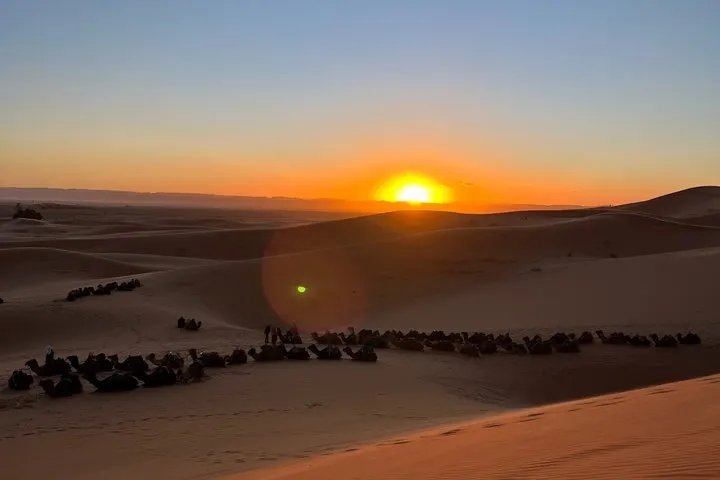
Spring is our most requested season, and for good reason. The drive over the High Atlas is at its most dramatic, with snow on the peaks and fresh green barley fields in the valleys. By the time you reach Merzouga, the sand is warm underfoot and the sunset camel ride is comfortable in a light layer.
One thing to know: spring is also the windiest time of year in the pre-Sahara. Some afternoons bring blowing sand that softens the horizon. It rarely stops a tour, but a scarf or cheche (desert turban) makes a real difference. By late May, midday temperatures climb into the 30s, so we plan stops in the shade of the gorges.
Summer in the Sahara (June to August)
Summer is the most misunderstood season. Yes, it is very hot: Merzouga regularly reaches the low 40s in July and August. But the air is dry, the mornings and late evenings are beautiful, and nights at camp are warm enough to sleep outside on the dunes, under some of the clearest skies in the country.
If you visit in summer, we adjust the rhythm of the trip:
- Early departures to cross the plateaus before the heat peaks.
- Long lunch breaks in the shade of the Todra Gorge or Dades Valley.
- Camel rides only in the late afternoon and at sunrise.
- Plenty of water in the vehicle, and air conditioning throughout.
Summer suits travellers who are used to heat and who are happy to rest in the middle of the day. It is less suitable for young children, older travellers or anyone with heat-sensitive health conditions.
Autumn in the Sahara (September to November)
Autumn rivals spring as the best season. Early September is still hot, but from the middle of the month temperatures fall steadily. October is close to perfect: warm, clear days, mild nights and a gentle light for photography. The palm groves around Erfoud and the Ziz Valley are busy with the date harvest, and you can buy fresh dates by the roadside.
November is quieter and slightly cooler, with evenings at camp that call for a sweater around the fire. It is an excellent month for travellers who prefer fewer people on the dunes.
Winter in the Sahara (December to February)
Many people are surprised to learn that the Moroccan Sahara is cold in winter. Days are often sunny and pleasant, around 17–22°C, but once the sun sets, temperatures drop quickly and can fall close to freezing in the early hours. Desert camps provide thick blankets, but you should still bring a warm jacket, hat and thermal layer.
Winter also affects the drive. Snow can briefly close the Tizi n'Tichka pass after a storm, so we keep an eye on conditions and occasionally adjust departure times. The reward is a crystal-clear sky full of stars and a much calmer desert. Christmas and New Year are busy, so book early for those dates.
Other factors that affect timing
Ramadan
The dates of Ramadan move earlier by around 10–11 days each year because they follow the lunar calendar. Tours continue as normal, and restaurants on the tourist route stay open, but some village cafés may close during the day. It can be a rich time to experience Moroccan hospitality, especially at the evening meal that breaks the fast.
Sandstorms and wind
Strong winds are most common in spring. A genuine sandstorm is uncommon, and our team will adjust the camel ride if conditions are poor. Protect your camera and phone in a zip bag on windy days.
Stargazing and moon phases
If seeing the Milky Way is a priority, try to plan your desert night close to a new moon. A full moon is magical in its own way, lighting the dunes silver, but it washes out fainter stars.
The best time for specific desert experiences
- Photography: October to March, when the air is clear and the low sun gives long shadows on the dunes.
- Families with children: March, April, October and November, avoiding the extremes of heat and cold.
- Sleeping outside on the dunes: June to September, when nights stay warm.
- Quiet dunes and lower demand: late November, January and February, outside the holiday weeks.
- Combining desert and mountains: April and May, when the Atlas passes are clear and the valleys are green.
In short, the best time to visit Sahara desert Morocco depends on your priorities as much as the thermometer.
Choosing your trip for the season
In hot months, a longer trip lets you travel in shorter, cooler stages. Our 4-day Sahara desert tour breaks the drive into gentler days, which makes a real difference in July and August. In winter, the extra comfort of the luxury Sahara desert tour (MAD 2,500) is worth considering for cold nights. Short on time? An evening in the Agafay desert near Marrakech gives a taste of desert landscapes without the long drive, although it is a stony desert rather than sand dunes.
Once you have picked your month, read our guide to the Marrakech to Merzouga route and our seasonal desert packing checklist. For general information on the country and its regions, the official Visit Morocco website is a useful starting point, and the Merzouga entry on Wikipedia gives a good geographical overview.
Found your perfect month for the Sahara?
Tell us your dates and we will plan the timing of your camel ride, camp and drive around the season. Book the 3-Day Marrakech to Merzouga Desert Tour or ask Walid on WhatsApp at +212 611-965381.
Frequently asked questions
What is the best month to visit the Sahara in Morocco?
Is it too hot to visit the Moroccan Sahara in summer?
How cold does the Sahara get at night in winter?
Does it rain in the Moroccan Sahara?
Founder of Pure Morocco Experience, born and based in Morocco. Walid and his team of drivers and guides run desert tours from Marrakech every week. More about us.