Desert Tours
Marrakech to Merzouga: Distance, Route & How Many Days
The drive from Marrakech to Merzouga covers about 550–560 km and takes roughly 9–10 hours without stops. Most travellers split it over 2 or 3 days on a guided tour, crossing the High Atlas via the Tizi n'Tichka pass, visiting Aït Benhaddou and the Dades Valley, then riding camels into the Erg Chebbi dunes.
- Distance: about 550–560 km by road (N9 and N10)
- Pure driving time: around 9–10 hours; 11–12 hours with photo and meal stops
- Highest point: Tizi n'Tichka pass, about 2,260 m
- Most popular format: 3 days / 2 nights (Dades Valley + desert camp)
- Our 3-day tour: from MAD 1,200 per person (about €110), standard camp
Every week our drivers make the journey from Marrakech to Merzouga, and the most common question we hear before departure is simple: how far is it really, and how many days do I need? This guide answers both, with the exact route, realistic driving times and an honest comparison of 2-, 3- and 4-day options. If you already know you want the classic version, our 3-day Marrakech to Merzouga desert tour follows exactly the route described below.
How far is Marrakech to Merzouga?
By road, Merzouga lies about 550–560 km east of Marrakech, on the western edge of the Erg Chebbi sand sea near the Algerian border. As the crow flies the distance is shorter, but the High Atlas Mountains sit between the two, so every route has to climb over them.
The distance itself is not the challenge. The mountain section is slow, with hairpin bends, trucks and frequent roadworks, and the long stretches across the pre-Saharan plateaus are tiring after several hours. That is why very few people attempt the trip in a single day.
The Marrakech to Merzouga route, stage by stage
There is one main road route, and it happens to be one of the most scenic drives in North Africa. Here is how it breaks down, with approximate distances.
| Stage | Approx. distance | Approx. driving time | Highlights |
|---|---|---|---|
| Marrakech → Tizi n'Tichka | about 140 km | 2.5–3 h | High Atlas hairpins, Berber villages, argan and walnut trees |
| Tizi n'Tichka → Aït Benhaddou | about 50 km | 1 h | UNESCO-listed ksar, film locations |
| Aït Benhaddou → Ouarzazate | about 30 km | 30 min | Film studios, Taourirt Kasbah |
| Ouarzazate → Dades Valley | about 120 km | 2 h | Valley of Roses, Skoura palm groves, Dades gorge |
| Dades Valley → Todra Gorge | about 70 km | 1–1.5 h | Sheer canyon walls up to around 300 m |
| Todra Gorge → Merzouga | about 190 km | 3 h | Desert plateaus, Erfoud, first view of the dunes |
Distances are rounded and vary slightly depending on where you stay in the Dades Valley and which side of Merzouga your camp is on.
Over the High Atlas: Tizi n'Tichka
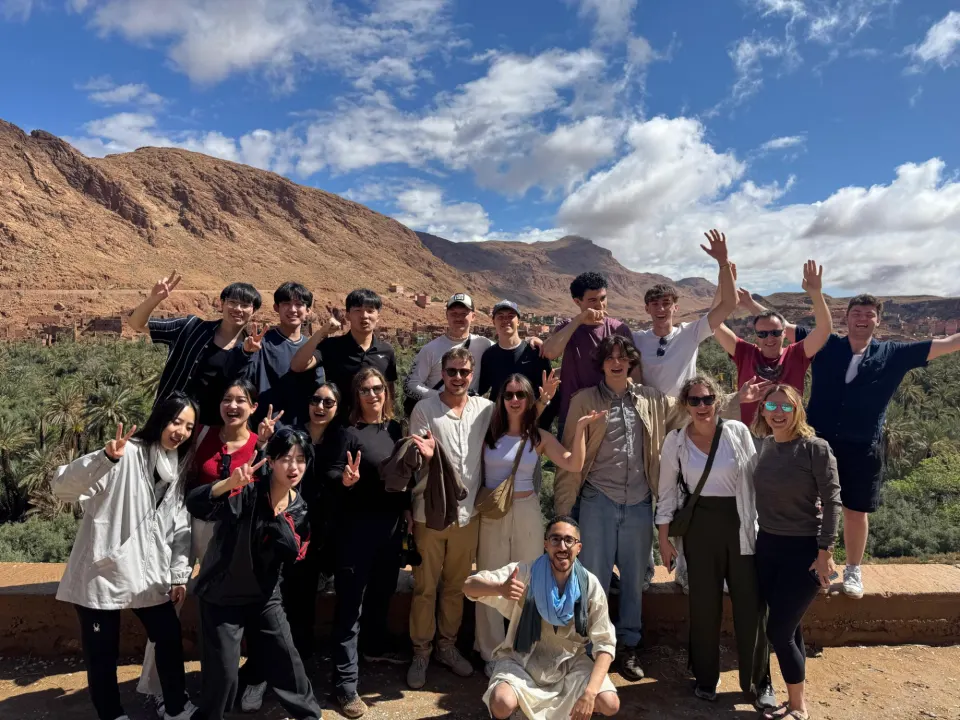
The N9 leaves Marrakech heading south-east and climbs steadily into the High Atlas. Tizi n'Tichka, at about 2,260 m, is the highest major road pass in Morocco. In winter you may see snow on the surrounding peaks, so the road can occasionally close for a few hours after heavy snowfall.
Aït Benhaddou and Ouarzazate
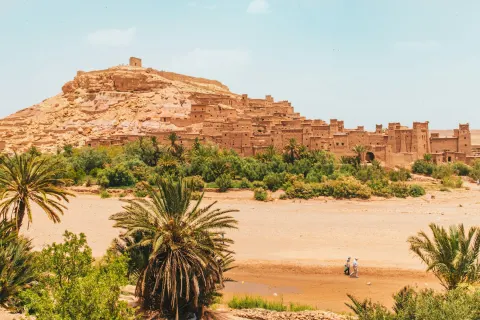
Just off the main road, the fortified village of Aït Benhaddou is a UNESCO World Heritage Site and one of the best-preserved earthen ksour in the country. It has appeared in films such as Gladiator and in Game of Thrones. We cover its history and the best viewpoints in our Aït Benhaddou guide.
Dades Valley and Todra Gorge
East of Ouarzazate, the N10 follows the "Road of a Thousand Kasbahs" through Skoura, Kelaat M'Gouna and Boumalne Dades. Most 3-day tours spend the first night in the Dades Valley, then visit the Todra Gorge near Tinghir the next morning, when the light in the canyon is softer and the tour buses have not yet arrived.
The final stretch to Erg Chebbi
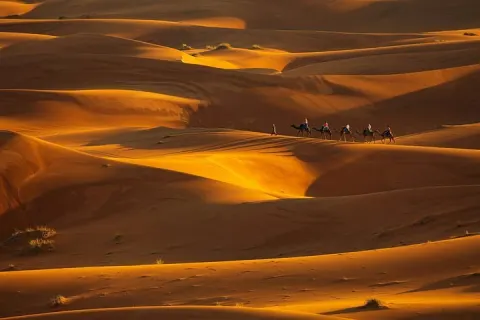
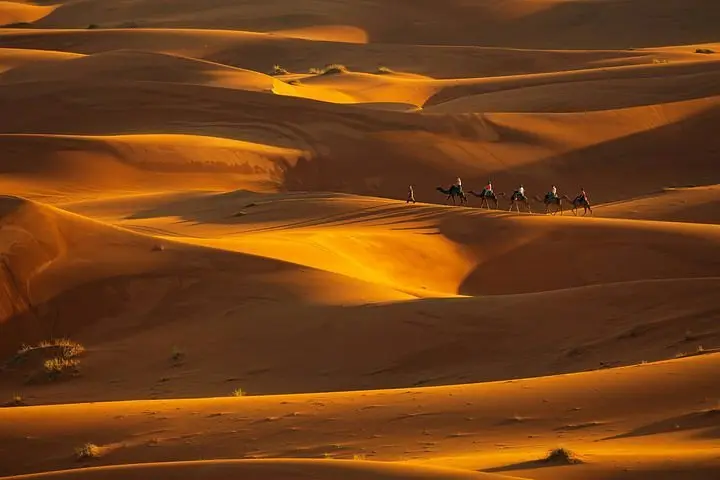
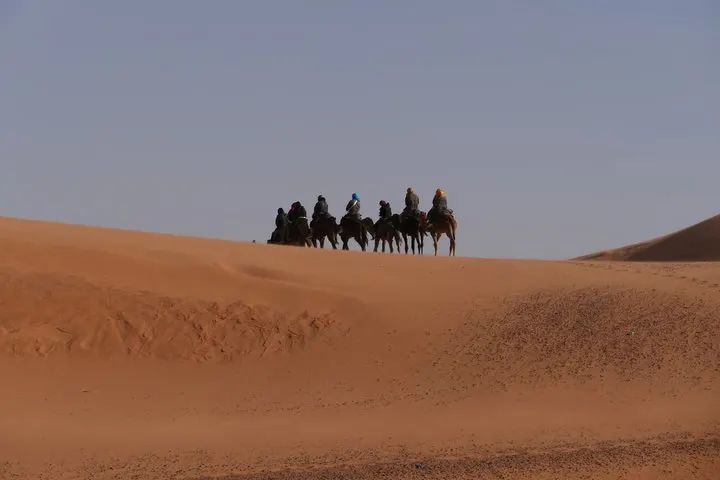
After Tinghir the landscape opens into stony hamada. You pass Tinejdad and Erfoud, known for its fossils and dates, before the orange dunes of Erg Chebbi appear on the horizon. The highest dunes rise to roughly 150 m, and this is where the camel ride to camp begins.
How long is the drive from Marrakech to Merzouga?
Allow around 9–10 hours of pure driving. Realistically, with fuel, lunch, photo stops and a short visit to Aït Benhaddou, a one-day transfer becomes 11–12 hours on the road. That is possible for an experienced driver, but it leaves you arriving after dark, missing the sunset camel ride, and seeing the most beautiful landscapes through a car window.
Our recommendation is to treat the drive as part of the experience rather than an obstacle. Breaking it into stages of 4–6 hours per day keeps everyone fresh and gives you time to walk in the gorges and drink tea in the villages.
How to get from Marrakech to Merzouga
There are four realistic options. Each suits a different budget and travel style.
1. Guided desert tour (most popular)
A small-group or private tour includes transport in an air-conditioned minivan or 4x4, a driver who knows the mountain road, a night in the Dades Valley, the camel trek and the desert camp. It removes all the logistics and is usually the best value once you add up accommodation and meals.
2. Private driver
Hiring a private driver gives you full control of the timing and stops. It costs more than a shared tour but is ideal for families, photographers or couples who want flexibility. A tailor-made private Morocco tour can include Merzouga as one part of a longer trip.
3. Self-drive with a rental car
The roads are paved all the way to Merzouga and generally in decent condition. Self-driving is perfectly feasible if you are comfortable with mountain roads, slow trucks, roaming livestock and occasional police checkpoints. You will still need to arrange the camel trek and camp separately, and you should avoid driving the Tichka pass at night.
4. Bus
National coach companies such as CTM and Supratours run services towards Merzouga, often overnight, with journeys of around 12–14 hours. It is the cheapest option but the least comfortable, and you see very little of the scenery. Check schedules locally, as they change by season.
There is also a regional airport at Errachidia, roughly 130 km from Merzouga, with limited flights usually routed via Casablanca. For most visitors starting in Marrakech, the road remains the practical choice.
2, 3 or 4 days from Marrakech to Merzouga: which is best?
The number of days changes the pace far more than it changes what you see. Here is an honest comparison.
| Option | Nights | Daily driving | Best for | Main trade-off |
|---|---|---|---|---|
| 2 days (Zagora) | 1 in desert camp | 7–8 h | Very tight schedules | Zagora is not Merzouga; smaller, flatter dunes |
| 3 days (Merzouga) | Dades Valley + desert camp | 5–9 h | Most travellers | Long final day back to Marrakech |
| 4 days (Merzouga) | Dades + 2 in the desert region | 4–7 h | Relaxed pace, families, photographers | Needs an extra day |
Is a 2-day trip from Marrakech to Merzouga possible?
Technically yes, but we do not recommend it: you would spend about 20 hours in a vehicle in 48 hours. Most "2-day desert tours" from Marrakech actually go to the Zagora dunes, which are closer but far less impressive. We compare the two areas in detail in Merzouga vs Zagora.
The 3-day tour: the classic choice
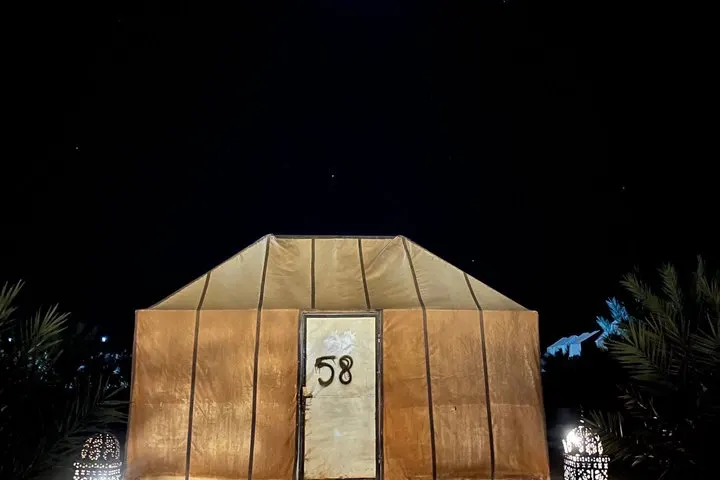
Three days is the sweet spot. Day one crosses the Atlas to Aït Benhaddou and the Dades Valley. Day two continues through the Todra Gorge to Merzouga for a sunset camel ride and a night at camp. Day three starts with sunrise over the dunes, an optional quad bike session, and the long drive back to Marrakech. Our best-selling 3-day desert tour starts from MAD 1,200 per person with a standard camp, or MAD 2,500 for the luxury camp version.
The 4-day tour: more time in the desert
With a fourth day you split the return journey and spend more time around Merzouga: visiting the Gnawa village of Khamlia, the nomad families around the dunes, or simply resting at camp. The 4-day Sahara tour is our favourite for families with children.
Not returning to Marrakech?
If your trip continues north, you can finish in Fes instead. The Marrakech to Fes desert tour (from MAD 1,800) saves you the long drive back.
Practical tips for the journey
- Motion sickness: the Tichka road has many bends. Take tablets before departure and sit near the front.
- Cash: carry some dirhams for lunches, tips and village shops; card payment is rare outside towns.
- Overnight bag: pack a small backpack for the desert night so your main luggage can stay in the vehicle. Our desert packing list covers exactly what to bring.
- Season: the drive is most comfortable in spring and autumn. Summer brings extreme heat in Merzouga and winter brings cold nights; see the best time to visit the Sahara.
- Travel advice: check your government's guidance, such as the UK foreign travel advice for Morocco, before you go.
Ready to make the journey from Marrakech to Merzouga?
Let our local drivers handle the road while you enjoy the Atlas, the gorges and a night under the Sahara stars. Book the 3-Day Marrakech to Merzouga Desert Tour or message Walid on WhatsApp at +212 611-965381 for availability.
Frequently asked questions
How many hours is Marrakech to Merzouga by car?
Is it safe to drive from Marrakech to Merzouga?
Can I do Marrakech to Merzouga in 2 days?
How much does a Marrakech to Merzouga tour cost?
Founder of Pure Morocco Experience, born and based in Morocco. Walid and his team of drivers and guides run desert tours from Marrakech every week. More about us.